
Last week, we approached our insurer Admiral UK for a quote to take Impi back into the Pacific. They asked us questions about our self sufficiency. We also discussed the preparation of the boat for long passages to remote areas.
This blog talks about our auto pilot set up as well as the redundancy and maintenance on Impi. We are going to turn to our auto pilot set up first. This is particularly important on a catamaran that is sailed just double handed.
3 Auto Pilots
Self steering is crucial for safe ocean passages. It helps the crew to stay well rested and focused. We have two separate and complete systems. They are fitted and ready to be operated. These are a B&G system and a Raymarine system. The systems can be activated or deactivated at the turn of a switch to select the unit to be used. Additionally, we carry a 3rd unit in sealed bag.
Spare Parts
We also carry spare parts for the auto pilot (AP) system e.g. two rudder response units (RRU). We have been the boat to transfer parts to other boats at sea. This happened because their RRU failed.
Each system has its own compass and separate control head.
Steering Cables and Steering Pole
We also carry the swivel ends for the steering pole. If these fail or become clogged with dust or rust, it becomes an issue to steer the boat. This places enormous pressure on the hydraulic rams. This affects the autopilot too and in severe cases can make the auto pilot useless.
This year we replaced the steering cables and chain for manual steering. We carry a spare chain and master links as spares on the boat. The idea is to have redundancy not only from one AP to the next but also parts for each.
In addition, we carry a lot of surplus oil specific to the units. We do this in case of a seal failure. This is because the oil grade and type is ‘specific’.
Hydraulic Ram
The hydraulic ram component of each system can be switched across to integrate or operate under either system control. It can be controlled by the B&G system or Raymarine system. This provides further redundancy.
Our B&G H5000 unit is our primary AP system. The hydraulic ‘Pilot Ram’ is the heavy duty T3. This model is an upgrade to the standard issue and is a more expensive option. However, to me this is invaluable. It prevents the AP from ‘letting go’ halfway down a wave face. This situation is dangerous.
The T3 is really designed for larger boats (Performance sailboats) for maximum torque and reliability in demanding conditions. For reference the T1 provides a max rudder torque up to 100Nm, The T2 a max rudder torque at 120Nm and the T3 a max rudder torque 185nm. This is a significant step up in torque.
Navigation System
The B&G AP is integrated with a full B&G navigation system. There are two chart plotters fitted inside and on the bridge. A spare is to be purchased before we enter the Pacific.
Back Up Systems
Our back up AP is a Raymarine system. It is a totally independent system operating on a very basic separate network. The hydraulic ram is a T2.
The reasoning for keeping the backup system basic is to have less gear that can fail on the backup system. This means we use the ‘Heading Hold’ function. The AP does not see wind or any other data except position and heading. It sits on its own backbone network.
Our third back up is an AP in a bag. It is protected from the elements and offers a sort of Faraday protection from electromagnetic pulses or surges. This unit is an L&S (Lecomble & Schmitt).
Electrical System Set Up
On Impi we have different battery systems that are isolated.
We have the main house bank. It consists of three 400Ah batteries. These are wired in parallel to make a 1200Ah House Bank. Each 400Ah pack has its own management system. If one battery fails internally, the battery management system (BMS) will shut down that particular bank. This action is performed through the Battery Controller Unit (BCU). This process leaves the other two engaged.
If there were to be an external issue such as an overcharging alternator, all 3 packs would shut down. We have a switch at the dashboard that cuts the field to the alternator. It effectively turns the alternators off and should bring the batteries back online.
Let’s say the entire House Bank (i.e. all 3 packs) shuts down – then we are able to switch across to the engine start batteries to keep voltage to the autopilot.
Furthermore, we are otherwise able to move across to the generator battery. We therefore have a lot of redundancy. The systems all sit separately. The house bank potentially offers 3 fallback options within that one system. The engine start batteries provide two separate options. The generator is another option.
Many sailboat owners have systems that charge to one bank. Then, through DC-DC, they charge the engines or house bank depending on the wiring. This does kind of integrate systems. In contrast, we run on separate isolated systems of batteries. These include the house bank and engine start for two engines. These can be either independent or linked. There is also an isolated generator battery system.
The boat has two alternators per engine, equipped with temperature sensors. So, there is the house bank alternator and there is the engine start alternator on each engine. The main alternator for the house bank is wired with the other engine through the Balmar Regulator using a center fielder, which, when both engines are running, seeks to find the regulator delivering the best voltage and assigns that one reading to the batteries.
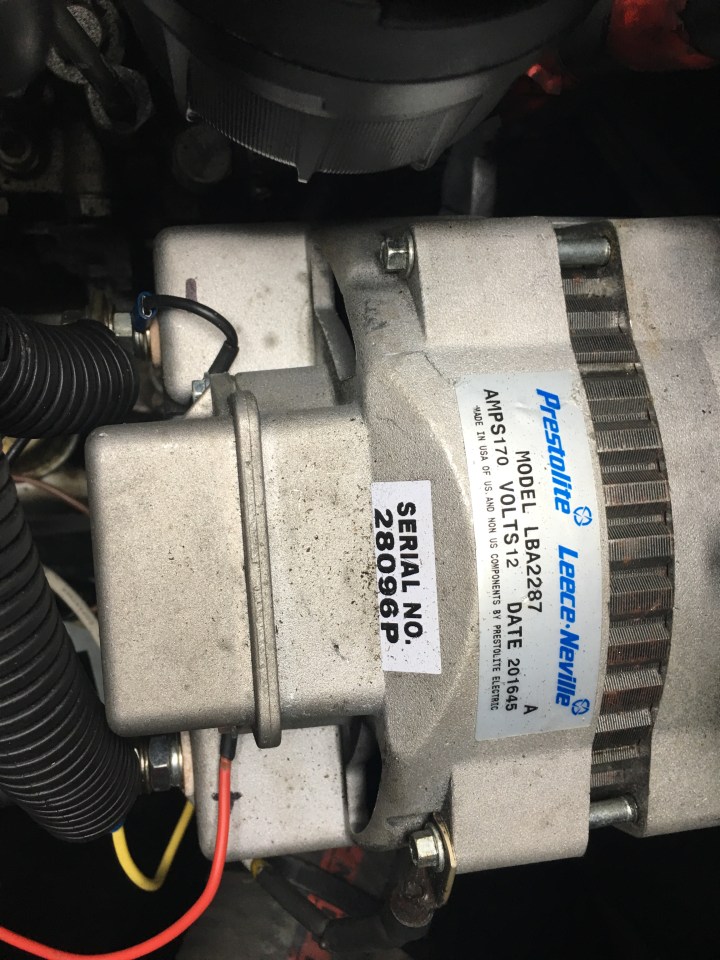
It’s a great device. It prevents the situation where two regulators otherwise see different voltages. They start ‘fighting’ each other, resulting in overcharge, undercharge or other damaging scenarios. This protects the batteries.
The engine start batteries are charged through the Yanmar (Hitachi) alternators. These alternators also have the ability, through the Cristec splitter, to charge both the house bank and engine start batteries. We installed an isolator switch on the house bank side of the Cristec Splitter. This ensures that the smaller alternator is now dedicated to the engine start batteries. In an emergency, one could turn on the Isolator Switch. This action would charge the house bank too. However, we prefer to keep the systems separate.
All this is monitored through our Victron System (CERBO) onboard.
Impi is also equipped with solar panels (SUNPOWER 400W x 4) each with its own trip switch. We have recently discarded our DC-DC Buck Step Down Regulator. We are looking to purchase a new one before entering the Pacific.
As further redundancy to the electrical system, we have two Victron Multiplus units, a master and a slave. We prefer this setup over the single Quatro system. If one unit fails, we can switch to ‘Stand Alone Mode’.
We can power the original Dolphin Charger (80A) through the Victron inverters or our generator. It charges the engine start batteries via AC.
Losing all the ‘separate systems’ and all sources to 12v (meaning all batteries onboard) would be HUGELY catastrophic. If that were to happen somehow, we’d have to resort to old practices. This includes locking the steering and setting up a stern bridle dragging warps with a ball out the stern. This would be done assuming we are moving with the wind aft of midship.
In calm conditions, you can adjust the steering pole ends. This adjustment allows for more ‘Toe Out’ or ‘Heel Out’ set up on the rudders. This is necessary because, otherwise, catamarans tend to wander a lot. Sail trimming and similar adjustments are also possible. However, this assumes there is ZERO redundancy left on the electrical system.
Emergency Tiller
Our catamaran is equipped with an emergency tiller. This ensures steering is possible if all else fails. It is useful when one can’t steer from the helm or a rudder has been lost. In that case the steering pole could be disconnected and one can steer the boat on one rudder.
Redundancy
We are focused on redundancy on Impi. We carry a lot of spares. For example, we have a complete second windlass unit and anchor as spare. This enables us to keep servicing units. I did a video of this which has helped many sailors.
We also have spare gearboxes for the electric winches. There is a spare freshwater pump and raw water pump for the engines. We also have a spare alternator, starter motors, and cylinder head gaskets. Additionally, we carry many Yanmar spares to overhaul the engines and sail drives if in remote locations. These blogs will help you to service several items on board.
How to service a Quick windlass

We use a great app on the boat. It’s called ‘Card Filer’, and it tells us where everything is stored. It also provides photos.
Engine Maintenance
I could share more about our maintenance programs which we do regularly and thoroughly. For example, recently in South Africa, I had the Yanmar agents remove both engines and gearboxes. They made sure to replace o’rings, gaskets, and external gear. This was part of our preventative maintenance.
Furthermore, we had them do injector spray pattern and leakage tests. We also conducted compression tests. These procedures assured me that the engines are in really good condition.

We also have done many safety upgrades, such as rebuilding our engine rooms with additional bulkheads and bilge pumps.
Escape Hatches
Many escape hatches have failed on boats causing them to sink. We went to great lengths to ensure the escape hatches are ‘fail proof’. As a result, many sailing vessels around the world have adopted our system.
This includes the likes of some well known YouTube people like Sailing Nahoa. They make mention of this flaw. The manufacturer tried to remedy the issue with two flimsy brackets, which I don’t trust at all. These YT people have copied our system.
They reference us at 3:00 mins into the video. They explain the dangers in their own situation. Then they show how we resolved it at 9:24 mins into the video.
I do sometimes think it would be nice if insurers would discount boat owners who take the necessary care. Then again, incidents still happen such as our dismasting. That was a tough blow.
Thank you and wishing every one a happy weekend
 Catamaran Impi